
Health insurance for self-employed people and early retirees in Tampa and Florida (2026)
If you work for yourself or are retiring before 65 in Florida, you have two doors in 2026: a Marketplace plan on HealthCare.gov, priced by age and county with a premium tax credit if your household income is under the line, or a private underwritten plan, which prices on your health and can cost less if you are healthy but can decline you or exclude a condition. I’m JP SaintAmour, a licensed advisor based in Tampa (Florida license G340342, NPN 21146876), and I run both for you at no cost.
Free. Never a fee. 7 days a week, 8 a.m.–10 p.m. ET.
Written by JP SaintAmour · Figures checked September 14, 2026, page reviewed September 25, 2026 · Sources linked in each section
Three Florida numbers that explain your renewal notice
Benchmark premium, age 40
$515 → $683 a month
KFF’s Florida benchmark (the second-lowest-cost Silver plan for a 40-year-old) averaged $515 a month in 2025 and $683 for 2026. KFF, checked September 14, 2026.
Approved rate change
+34.1% for 2026
Florida’s Office of Insurance Regulation approved an average individual-market premium increase of 34.1% for 2026, weighted by actual membership, with the average premium per person going from $648 to $867. Florida OIR, web table dated October 16, 2025.
The income line
$62,600 for one person
The enhanced premium tax credits expired December 31, 2025. Above 400% of the federal poverty level, $62,600 for one person or $84,600 for two, a Marketplace plan is full price in 2026. For the self-employed, the Marketplace counts net profit after expenses, not gross receipts, plus any other household income. Your tax preparer can confirm the number. Source: KFF and the 2025 HHS poverty guidelines, checked September 14, 2026.
What Florida Marketplace plans list for in 2026
These are statewide medians of the full list price for one adult, per month, before any tax credit, from the federal plan file. Your county, your exact age, and your income move the number.
| Plan | Age 40 | Age 50 | Age 60 |
|---|---|---|---|
| Lowest-cost Bronze plan | $515 | $720 | $1,093 |
| Benchmark Silver plan | $699 | $977 | $1,485 |
| Lowest-cost Gold plan | $675 | $944 | $1,434 |
Source: CMS QHP Landscape PY2026 Individual Medical file (data current as of August 4, 2026), statewide median across Florida’s 67 counties. Fifteen insurers offer Marketplace plans in Florida for 2026, 410 distinct plans, and 65 of 67 counties have three or more insurers to choose from. Florida uses the federal Marketplace, HealthCare.gov.
If a tax credit applies to you, your number is lower than the table, and the Marketplace is probably where you should be. I say that whenever it is true, which is often.
Your options, side by side
| Option | Who it fits | How it is priced | Pre-existing conditions | When you can apply |
|---|---|---|---|---|
| Marketplace plan with a tax credit | Household income under the 400% line | Age and county, minus your credit | Covered, guaranteed issue | Open enrollment, or a life event |
| Marketplace plan at full price | Income over the line, and anyone with a condition a private carrier would exclude | Age and county, list price | Covered, guaranteed issue | Open enrollment, or a life event |
| Private underwritten plan | Healthy households paying full price | Health, age, and ZIP code; the carrier decides | Can be declined, rated up, or excluded; not ACA coverage | Year-round, subject to approval |
| COBRA from a former employer | A short bridge when you want to keep the exact plan you had | The full premium plus up to a 2% fee | Covered | After the employer plan ends; typically 18 months (federal COBRA rule) |
| Short-term plan | A gap of months, not a year-round answer | Age and health | Usually excluded; not ACA coverage | Year-round; Florida allows initial terms under 12 months (Florida statute, checked February 13, 2026) |
Timing for 2027 coverage
Open enrollment for 2027 Marketplace coverage runs November 1, 2026 to January 15, 2027 on HealthCare.gov; enroll by December 15 for coverage starting January 1 (HealthCare.gov, checked September 14, 2026). A qualifying life event, such as losing employer coverage, a move, marriage, or a baby, opens a special enrollment period at any time of year. Private plans take applications year-round, subject to carrier approval, which matters if you missed a window or your situation changed mid-year.
Tampa Bay, quoted by county
I live and work in Tampa, and I meet clients in person around Tampa Bay when that is easier for them. Hillsborough, Pinellas, Pasco, and Hernando counties each have their own Marketplace rating and their own set of carriers, so a statewide median is only a starting point. When you call, I quote your county, your age, and your household, both ways: the Marketplace price with whatever credit you qualify for and, if you are healthy, a private quote. You should see both numbers on the first call.
The county-by-county numbers, including the cheapest plans by name for Hillsborough, Pinellas, Pasco and Hernando, are published on Browse Health Plans, the free price tool I built. Its Florida page covers all 67 counties.
When the Marketplace wins
You qualify for a credit, or you or someone in your household has a condition a private carrier would exclude. Guaranteed issue and pre-existing-condition coverage are worth more than a lower premium in that case, and I will say so.
When a private plan wins
You are over the income line, you are in good health, and you want a broader network or a lower monthly cost than the full-price Marketplace plan. The trade-off is underwriting: a carrier can decline you, charge more, or exclude a condition, and it is not ACA coverage.
Not in Florida?
I am licensed in 17 states. If yours is not one of them, Browse Health Plans, the free price tool I operate, shows your county's prices and a licensed advisor follows up.
Common Florida questions
I’m self-employed in Florida and my income changes every year. How is the credit figured?
On your estimate of this year’s household modified adjusted gross income. For a self-employed person that starts with net profit after expenses and adds any other household income, such as a spouse’s wages. You can update the estimate during the year if things change, and it is reconciled on your tax return. Your tax preparer can confirm the number.
Does Florida have its own Marketplace or state subsidies?
No. Florida uses the federal Marketplace, HealthCare.gov, and does not run a state subsidy program or a state individual mandate. Florida has also not expanded Medicaid, which affects lower-income households differently than in expansion states.
Can I keep my Tampa doctors on a private plan?
Often, but it depends on the carrier’s network, which is one of the first things I check for you. Tell me the doctors and hospitals that matter and I will confirm them before you apply, on either kind of plan.
I’m 62 and retiring in Florida next year. What should I do first?
Estimate your income in retirement, not your last working year. It is often lower, which can put you under the line for a credit. I check that first, then compare a private plan if you are healthy. When you turn 65 I point you to a Medicare specialist, because I do not sell Medicare plans. See retiring before 65.
Where can I file a complaint about a Florida insurer?
The Florida Department of Financial Services runs the Insurance Consumer Helpline at (850) 413-3089, Monday to Friday, 8 a.m. to 5 p.m. Eastern.
Verify my Florida license
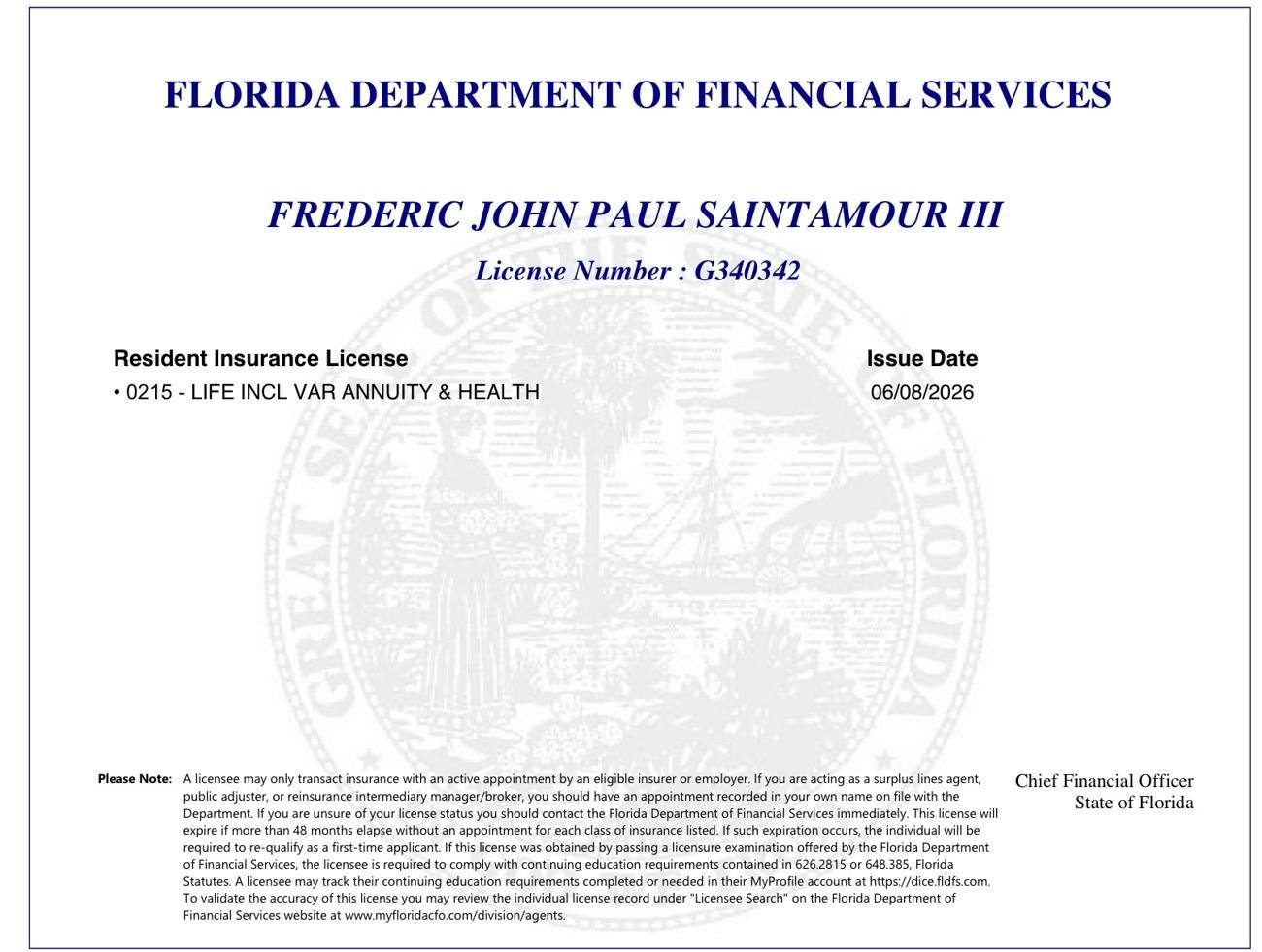
Florida resident license G340342 (2-15 Life, Health & Variable Annuity), issued to Frederic John Paul SaintAmour III, NPN 21146876. Check it on the National Insurance Producer Registry or the Florida DFS licensee search.

JP SaintAmour, Licensed Health Insurance Advisor, Tampa, FL (Florida license G340342, NPN 21146876). Figures on this page come from KFF, the Florida Office of Insurance Regulation, CMS, and HealthCare.gov, each dated above, and are re-checked when they change. Not medical, legal, or tax advice.
Get your two numbers. It takes one call.
7 days a week, 8 a.m.–10 p.m. ET · Never a fee